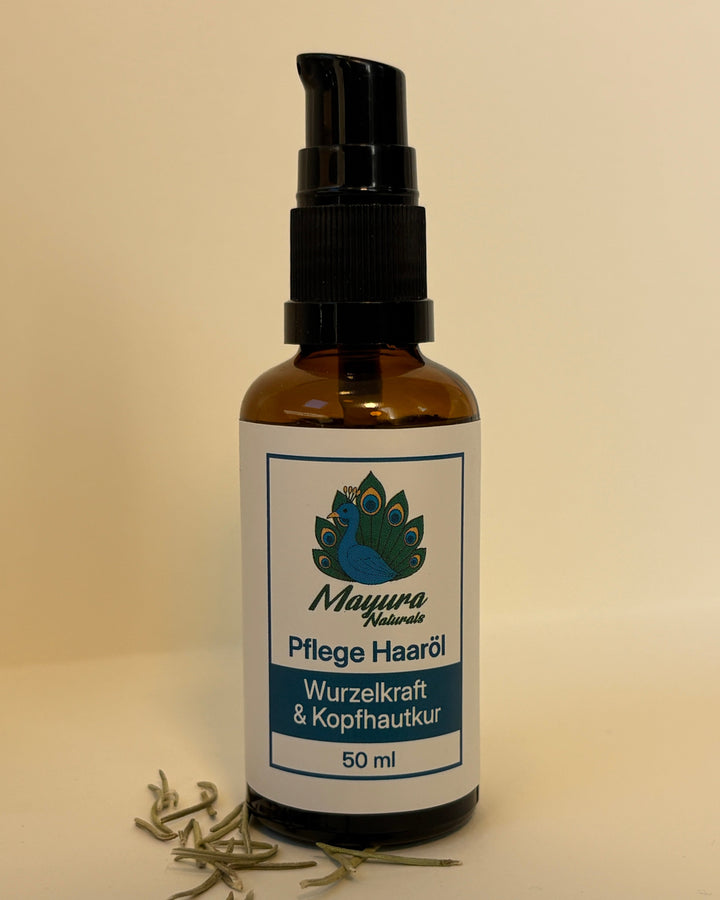
Discover the plants in our formula and learn how they can support the care of hair roots, the scalp, and hair.
The described properties refer to the individual raw materials. In our hair oil, they combine to form a balanced care formula.
Hair roots and hair growth
Rosemary oil
Rosemary oil is one of the most interesting plant oils for hair root care. With regular use, it can support natural hair growth and contribute to thicker-looking hair. (Panahi et al., 2015) Its essential plant compounds revitalize the scalp, while the fresh, herbaceous scent activates the care ritual and accompanies the treatment of the scalp and hair roots.
Pumpkin seed oil
Pumpkin seed oil provides valuable fatty acids, phytosterols, and natural antioxidants. Phytosterols are bioactive plant components linked to hair growth and hair density. (Ibrahim et al., 2021) Together with nourishing fatty acids, they support the scalp and hair roots, making the oil a nourishing treatment for thinning-looking hair.
Saw palmetto oil
Saw palmetto oil is a specifically selected plant active ingredient for thinning hair. It contains, among other things, beta-sitosterol, a plant component linked to processes involving hormonally induced hair loss. With regular use, saw palmetto oil can help reduce hair loss, support hair density, and provide targeted care for thinning hair. (Sudeep et al., 2023)
Bhringraj
Bhringraj is one of the most traditional plants in Indian and Ayurvedic hair care. Its plant compounds are linked to the natural growth cycle of hair follicles and can influence the signaling molecules FGF-7 and FGF-5: FGF-7 supports the onset of the growth phase, while FGF-5 helps control its end. (Lee et al., 2019) In our hair oil, Bhringraj complements the intensive care of the scalp and hair roots.
Peppermint oil
Due to its natural menthol content, peppermint oil provides an immediately cooling and invigorating sensation on the scalp. Menthol activates the skin's cold receptors, creating that characteristic freshness. (Dillon et al., 2022) At the same time, peppermint oil shows potential for supporting hair follicles and the active growth phase, providing an activating boost of freshness for the scalp. (Oh et al., 2014)
Scalp care
Lavender oil
Lavender oil complements scalp care with skin-nourishing properties and a soft, aromatic fragrance. Lavender oil is also associated with pain-relieving properties. (Ghods et al., 2015) In the hair oil, lavender completes the care, forming a calm counterpoint to the fresh notes of rosemary and peppermint.
Black cumin oil
Black cumin oil combines nourishing fatty acids with thymoquinone, a natural plant compound with antioxidant properties. Antioxidants help protect the scalp from harmful external influences. The rich oil nourishes stressed scalps, supports a calm skin sensation, and provides intensive care and protection. (Khatoon et al., 2024)
Sesame oil
Sesame oil is a classic base oil in Ayurvedic care. Its unsaturated fatty acids help keep the scalp supple and give dry hair a softer, more nourished feel. (Mysore & Arghya, 2022) The rich texture is particularly suitable for a thorough scalp massage and also serves as a nourishing carrier base for the Bhringraj extract.
Hair care and protection of the hair fiber
Coconut oil
Coconut oil has a special affinity for the hair fiber. This is primarily due to lauric acid, a fatty acid that can penetrate the hair well and reduce the loss of hair proteins. (Rele & Mohile, 2003) Coconut oil can also positively influence the hair surface and the interaction between hair and scalp, thus offering deep conditioning and protection before washing. (Saxena et al., 2021)
Argan oil
Argan oil is considered a particularly precious and rich plant oil, lending a luxurious character to hair care. It contains unsaturated fatty acids and natural antioxidants. The fatty acids nourish and smooth the hair surface. Antioxidants help protect hair from oxidative stress that can arise from external influences. As a result, argan oil can provide more protection, suppleness, and shine to dry and stressed hair. (Sharifi et al., 2022)
Jojoba oil
Technically, jojoba oil is not a classic oil, but consists mainly of liquid wax esters. Due to this special composition, it is frequently used in cosmetic skin care formulations. (Pazyar et al., 2013) As a nourishing conditioner, jojoba oil can reduce protein loss, protect the hair fiber, and improve both manageability and resistance to hair breakage. (Dias et al., 2008) Its light texture complements the formula as a smooth care base for scalp and hair. For care without weighing hair down.
Vitamin E (Tocopherol)
Our vitamin E is naturally derived from sunflower seeds and soybeans. Under the technical name tocopherol, it acts as an antioxidant and protects against oxidation. During this process, oils react with oxygen and can thereby lose quality. (Barouh et al., 2022) Vitamin E complements the nourishing properties of the plant oils for hair and scalp, while simultaneously protecting and stabilizing the high-quality oil blend. (Ahn et al., 2022)